INFORMATION GATHERING
DETAILS and COMMENTS

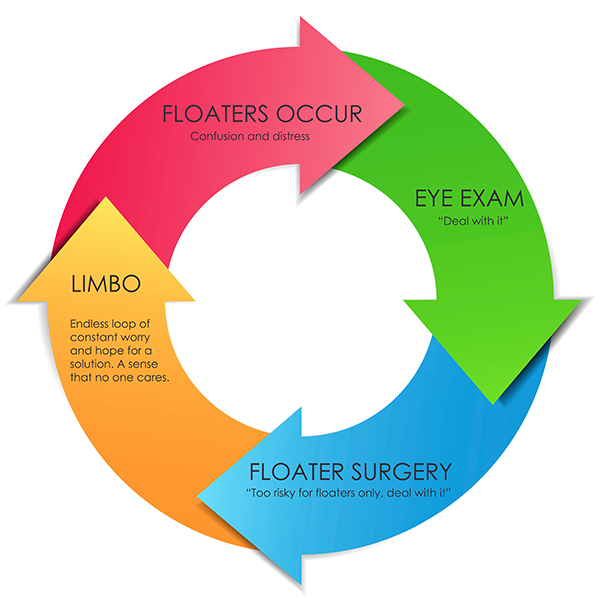
As mentioned, in the Fall of 2024 I had a PVD in each eye resulting in two large central floaters, making my life miserable. Rather than ‘live with it’ I decided to take back control of my sight. With herbal and laser out of the picture I approached a highly respected hospital near me about a Core Floater-Only Vitrectomy (FOV). They regularly perform Fulls but I don’t think anyone had ever approached them formally about getting one done only for floaters. Surprisingly, they were open minded and actually discussed my request internally, but said no. They weren’t worried about causing cataracts or the procedure's effectiveness, but felt the risk of retinal detachment was too high for “just floaters”. In other words, they didn’t like the risk/benefit ratio.

I began a search of the 19,000 board-certified eye surgeons in the US. Yet despite Core Vitrectomies for Floaters becoming more prevalent in the past few years, finding a surgeon that did one wasn't easy. A surgeon receives a referral from another MD before performing a procedure, which for a FOV is unlikely being 'not standard of care'. A sufferer approaching a surgeon directly runs into another hurdle: the insurance company. Health insurers require prior-approval for surgery and a patient circumventing the referral process is nearly always denied.


AFTER RESEARCH HERE IS WHAT I GLEANED
 
  • Retinal Detachment occurs naturally in about 1% of the population. A FOV can increase this to about 2%.
  • The vitreous is 4 to 5 CC in volume while the distance from the lens to the retina is 17mm. A Full vitrectomy can accelerate cataracts because the rear of the lens capsule is exposed and can begin to oxidize. A Core leaves more vitreous behind the lens which is said to result in fewer complications and slower cataract formation.
  • The aqueous humor is a clear fluid that fills the chambers of the eye. The body normally cycles the aqueous every few hours to cleanse the eye (not the gel-like vitreous unfortunately). During a Core, saline is used to replace the central vitreous. The eye gradually replaces the saline with new aqueous after surgery.
  • For a Core, a patch is not worn afterwards letting the eye breath openly to heal. An eye protector for sleeping is required for a short period.
  • A Core FOV can take 10 minutes. Mild sedation is optional.


A surgeon estimated that being in my early 60s cataracts were likely to appear naturally in 5 years. Getting a Core might reduce that to 2-3 years. I decided the 2% risk of retinal detachment was acceptable to me. I reminded myself of the tactic used to scare people away from a FOV: that it can accelerate cataracts. Well, the risk of them forming is not worrisome to me. My attitude that I would much rather have floater-free vision and the possibilty of a cataract, than floaters for life with the possibility of a cataract. People who use RLE to get rid of glasses and contacts don't have the same anxiety about lens replacement, which is worth noting.

After much research and consideration I selected Coastal Eye in Connecticut who specifically and regularly perform FOVs and have the experience, finesse, and progressive style that fit my needs. I scheduled the procedure which is detailed on the next page.


Datsunzgarage.us © 1997-2026

All comments are anecdotal only. This is not medical advice.
Datsun is a registered trademark of Nissan ®